Quick Update
Friends,
I have moved to USA and I'm not able to participate in any swaps or not doing any private trades either.
I will keep you all posted when I start again.
Keep Smiling,
~Abhishek
Write to me
Friends,
I have moved to USA and I'm not able to participate in any swaps or not doing any private trades either.
I will keep you all posted when I start again.
Keep Smiling,
~Abhishek
Write to me
Friends,
Sorry that I've not been active since quite some time now due to a very busy schedule at work. Due to the same reason, I've not been able to update my blog too. I hope to be back soon. I still have a lot of missing WHS postcards (http://postcrossing.vndv.com/listmissing.php) that I would need help on. Thanks a lot for your good wishes.
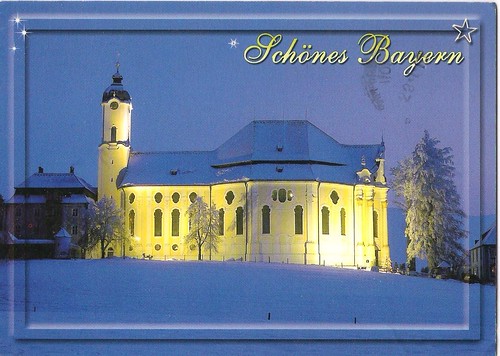
The Pilgrimage Church of Wies is an oval rococo church, designed in the late 1740s by Dominikus Zimmermann, who for the last eleven years of his life lived nearby. It is located in the foothills of the Alps, in the municipality of Steingaden in the Weilheim-Schongau district, Bavaria, Germany.
The Wieskirche was added to the UNESCO World Heritage List in 1983 and underwent extensive restoration between 1985 and 1991.
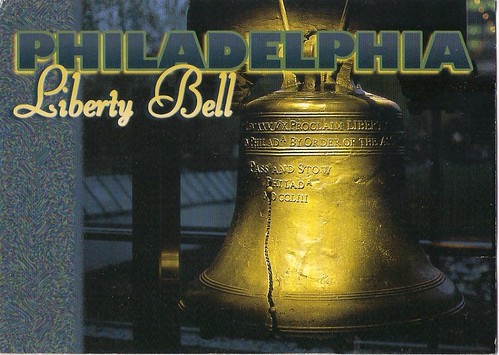
The Liberty Bell, in Philadelphia, Pennsylvania, is one of the most prominent symbols of the American Revolutionary War. It is a familiar symbol of independence within the United States and has been described as an icon of liberty and justice.
According to tradition, its most famous ringing occurred on July 8, 1776, to summon citizens of Philadelphia for the reading of the Declaration of Independence. Historians today consider this highly doubtful, as the steeple in which the bell was hung had deteriorated significantly by that time. The bell had also been rung to announce the opening of the First Continental Congress in 1774 and after the Battle of Lexington and Concord in 1775.
The Liberty Bell was known as the "Independence Bell" or the "Old Yankee's Bell" until 1837, when it was adopted by the American Anti-Slavery Society as a symbol of the abolitionist movement.
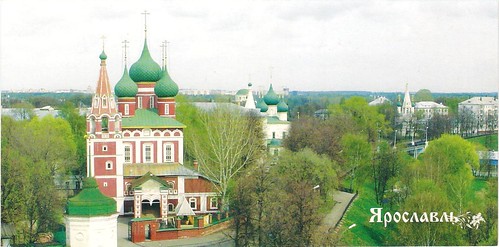
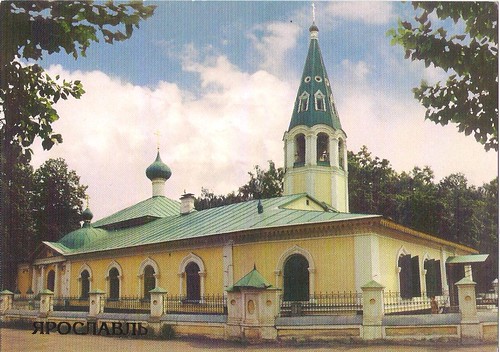
Yaroslavl is a city in Russia, the administrative center of Yaroslavl Oblast, located 250 kilometers (155 mi) north-east of Moscow. The historical part of the city, a World Heritage Site, is located at the confluence of the Volga and the Kotorosl Rivers.
The most ancient building in the city is the Spaso-Preobrazhensky ("Transfiguration of the Saviour") Cathedral of the Spassky (St Saviour) Monastery constructed in 1506—1516 on the foundations of the original edifice dating back to 1216—1224. Apart from the Spaso-Preobrazhensky ("Transfiguration of the Saviour") Monastery, the oldest churches in the city date back to the 17th Century and belong to the so-called Yaroslavl type (built of red brick, with bright tiled exteriors).
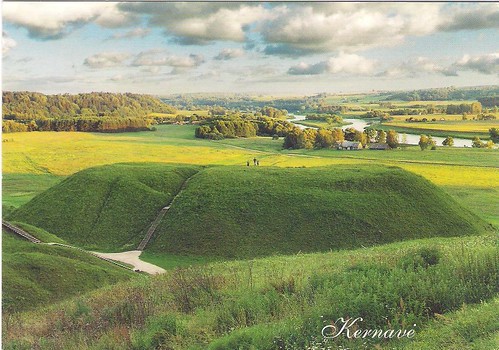
Kernavė was a medieval capital of the Grand Duchy of Lithuania and today is a tourist attraction and an archeological site. It is located in the Širvintos district municipality located in southeast Lithuania. Kernavė is situated near the bend of the Neris and the Pajauta valley, next to the area of historic hillfort mounds, piliakalnis.
Lithuania is the land of mounds. The number of mounds counts up to 1000, five of which are still left in Kernave. The oldest mound- the central altar mound - was inhabited in the 1st millenium BC. Pajauuta valley stretches behind the mound
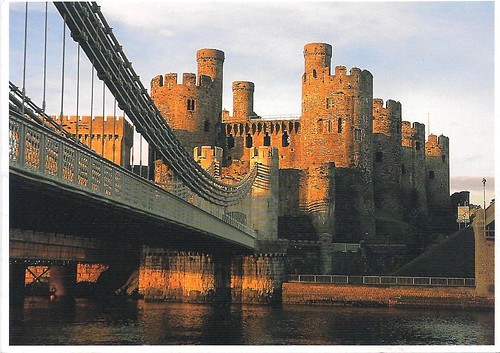
Conwy Castle is a castle in Conwy, on the north coast of Wales. It was built between 1283 and 1289 during King Edward I's second campaign in North Wales. Conwy replaced Deganwy Castle, an earlier stronghold built by Henry III that had been destroyed by Llywelyn the Last in 1263.
It is a part of UNESCO World Heritage Site, "The Castles and Town Walls of King Edward in Gwynedd".
In 1986, four castles related to the reign of King Edward I of England were proclaimed collectively as a World Heritage Site, as outstanding examples of fortifications and military architecture built in the 13th century. Sites designated were:
1. Beaumaris Castle, Anglesey
2. Caernarfon Castle, Caernarfon
3. Conwy Castle, Conwy
4. Harlech Castle, Harlech
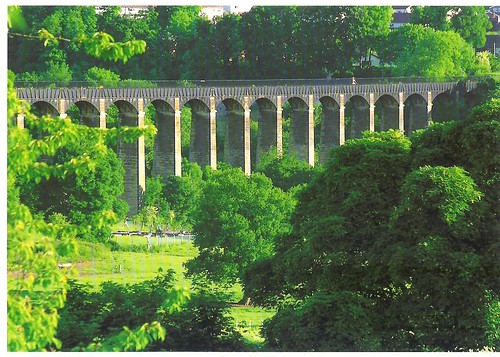
The Pontcysyllte Aqueduct is a navigable aqueduct that carries the Llangollen Canal over the valley of the River Dee, between the villages of Trevor and Froncysyllte, in Wrexham in north east Wales. Completed in 1805, it is the longest and highest aqueduct in Britain, a Grade I Listed Building and a World Heritage Site.
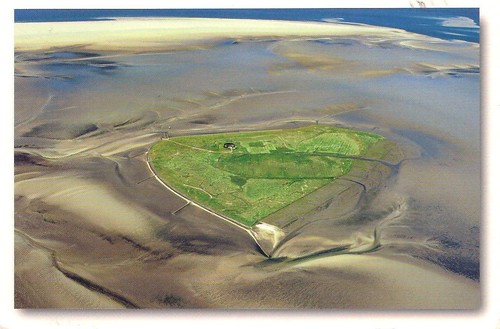
Read more...The postcard says "Piece of heart in the Wadden Sea - Hallig Süderoog".
Hallig Süderoog is one of the ten small German islands without protective dikes in the North Frisian Islands on Schleswig-Holstein's Wadden Sea-North Sea coast in the district of Nordfriesland.
At storm tide, the Hallig will be all under water, only the so-called "Warften" (metre-high man-made hills where the houses were built upon) stay above sea level.
Hallig Süderoog is part of Schleswig-Holsteinisches Wattenmeer National Park.
The Wadden Sea is an intertidal zone in the southeastern part of the North Sea. It lies between the coast of northwestern continental Europe and the range of Frisian Islands, forming a shallow body of water with tidal flats and wetlands. It is rich in biological diversity. In 2009, the Dutch and German parts of the Wadden Sea were inscribed on UNESCO's World Heritage List.
As per UNESCO WHS website:
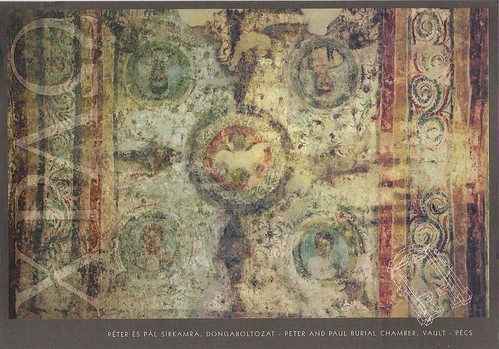
In the 4th century, a remarkable series of decorated tombs were constructed in the cemetery of the Roman provincial town of Sopianae (modern Pécs). These are important both structurally and architecturally, since they were built as underground burial chambers with memorial chapels above the ground. The tombs are important also in artistic terms, since they are richly decorated with murals of outstanding quality depicting Christian themes.
Cella Septichora: Built in the 4th century AD, the seven-foiled ground-plan of this late-Roman building is unique in the Danube region. Descending four to six metres to the former Roman surface level, we can see the wall, which remains two metres tall in parts.