Showing posts with label Panama. Show all posts

Thursday, October 1, 2009

Portobelo Fort, Panama
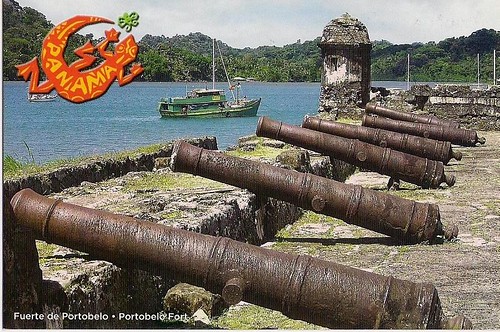

Panama-2, originally uploaded by Abhishek's Received Postcards.

Portobelo is a port city in Colón Province, Panama. It is located on the northern part of the Isthmus of Panama.
Portobelo was founded in 1597. From the sixteenth to the eighteenth centuries it was an important silver-exporting port in New Granada on the Spanish Main and one of the ports on the route of the Spanish treasure fleets. Today, Portobelo is a sleepy city with a population of fewer than 5,000. It has a deep natural harbor. In 1980 the ruins of the fortification, along with nearby Fort San Lorenzo, were declared a World Heritage Site.
According to www.worldheritagesite.org, "The Panamanian forts of Portobelo and San Lorenzo on the Caribbean coast form part of the defence system built by the Spanish Crown to protect transatlantic trade. They are magnificent examples of 17th- and 18th-century military architecture."

Read more...

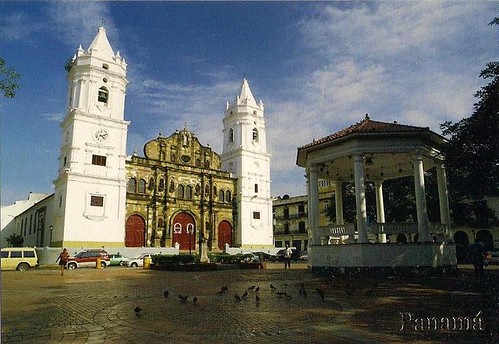
Cathedral and main square in the old quarter, Panamá Viejo, Panama


Panama-1, originally uploaded by Abhishek's Received Postcards.

Panamá Viejo is the remaining part of the old Panama City and former capital of the country. It is located in the suburbs of the modern city. Together with the historical district of Panamá, it forms a World Heritage Site.

The city was founded August 15, 1519 by Pedro Arias Dávila and other 100 inhabitants; at the time, it was the first permanent settlement in the Pacific Ocean, substituting the two cities of Santa María la Antiga del Darién and Acla. Two years later, in 1521, the settlement was promoted to the status of city by a royal decree and was given a coat of arms by Charles V of Spain, forming a new Cabildo. Shortly after its creation the city became a starting point for various expeditions in Peru and an important base where gold and silver were sent to Spain.

In 1539 and 1563, the city suffered some fires which destroyed parts of it but they did not harm the city's development. In 1610, the city reached a population of 5000, with 500 houses and some convents and chapels, a hospital and a cathedral.

Read more...