Showing posts with label Italy. Show all posts

Monday, November 9, 2009

Agrigento, Italy


Italy-42, originally uploaded by Abhishek's Received Postcards.

Agrigento, is a city on the southern coast of Sicily, Italy, and capital of the province of Agrigento. It is renowned as the site of the ancient Greek city of Akragas, one of the leading cities of Magna Graecia during the golden age of Ancient Greece.

Agrigento was founded on a plateau overlooking the sea, with two nearby rivers, the Hypsas and the Akragas, and a ridge to the north offering a degree of natural fortification. Its establishment took place around 582-580 BCE and is attributed to Greek colonists from Gela, who named it Akragas. The meaning of the word is unclear, though the stock commonplace referred to an eponymous legendary founder, an Akragante, apparently no more than a retrospective etiological myth for an obscure name.

Read more...

Isole Eolie(Aeolian Islands), Italy


Italy-43, originally uploaded by Abhishek's Received Postcards.

The Aeolian Islands or Lipari Islands are a volcanic archipelago in the Tyrrhenian Sea north of Sicily, named after the demigod of the winds Aeolus. The locals residing on the islands are known as Eolians. The Aeolian Islands are a popular tourist destination in the summer, and attract up to 200,000 visitors annually.
The largest island is Lipari. The other islands include Vulcano, Salina, Stromboli, Filicudi, Alicudi, Panarea and Basiluzzo.

Read more...

Villa Romana del Casale, Italy


Italy-45, originally uploaded by Abhishek's Received Postcards.

Villa Romana del Casale is a Roman villa built in the first quarter of the 4th century and located about 5 km outside the town of Piazza Armerina, Sicily, southern Italy. Containing the richest, largest and most complex collection of Roman mosaics in the world, it is one of 44 UNESCO World Heritage Sites in Italy.

The Villa was constructed (on the remains of an older villa) in the first quarter of the 4th century AD, probably as the center of a huge latifundium (agricultural estate) covering the surrounding area. How long the villa kept this role is not known, maybe for less that 150 years. The complex remained inhabited and a village grew around it, named Platia (derived from the word palatium (palace). The villa was damaged and perhaps destroyed during the domination of the Vandals and the Visigoths. The outbuildings remained in use, at least in part, during the Byzantine and Arab periods. The site was abandoned in the 12th century AD when a landslide covered the villa. Survivors moved to the current location of Piazza Armerina.

Read more...

Monday, October 5, 2009

The Dolomites, Italy


Italy-41, originally uploaded by Abhishek's Received Postcards.

The Dolomites are a section of the Alps. They are located for the most part in the province of Belluno, the rest in the provinces of Bolzano-Bozen and Trento (all in north-eastern Italy). Conventionally they extend from the Adige river in the west to the Piave valley (Pieve di Cadore) in the east. The northern and southern borders are defined by the Puster Valley and the Sugana Valley (Val Sugana). But the Dolomites spread also over the Piave river (Dolomiti d'Oltrepiave) to the east; and far away over the Adige river to the west is the Brenta Group (Western Dolomites); there is also another smaller group called Piccole Dolomiti (Small Dolomites) located between the Provinces of Trento and Vicenza (see the map).
One national park and many other regional parks are located in the Dolomites. In August 2009, the Dolomites has been declared natural heritage of the UNESCO.

Read more...

Monday, August 10, 2009

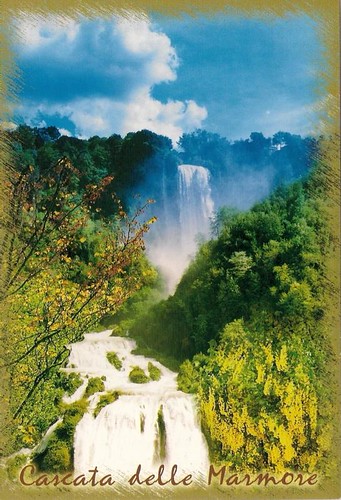
Cascata delle Marmore, Italy


Italy-40, originally uploaded by Abhishek's Received Postcards.

The Cascata delle Marmore (Marmore's Falls) is a man-made waterfall created by the ancient Romans. Its total height is 165 m (541 feet), making it one of the tallest in Europe and the tallest man-made waterfall in the world. Of its 3 sections, the top one is the tallest, at 83 m (272 feet).
It is located 7.7 km from Terni, a provincial capital of the Italian region of Umbria.

Read more...

Saturday, June 6, 2009

Royal Park,- Fountain of the Dolphins, Italy


Italy-39, originally uploaded by Abhishek's Received Postcards.

The Royal Palace of Caserta, in Italian Reggia di Caserta, is a former royal residence in Caserta, constructed for the Bourbon kings of Naples. It was the largest palace and probably the largest building erected in Europe in the eighteenth century.
The garden, a typical example of the baroque extension of formal vistas, stretch for 120 ha, partly on hilly terrain. It is inspired by the park of Versailles, but it is commonly regarded as superior in beauty. The park starts from the back façade of the palace, flanking a long alley with artificial fountains and cascades.

Read more...

S. Vitale Basilica, Ravenna, Italy


Italy-38, originally uploaded by Abhishek's Received Postcards.

Ravenna is a city and comune in the Emilia-Romagna region of Italy. The city is inland, but is connected to the Adriatic Sea by a canal. Ravenna once served as the seat of the Western Roman Empire and later the Kingdom of the Ostrogoths and the Exarchate of Ravenna. It is presently the capital of the Province of Ravenna. At 652.89 km² (252.08 sq mi), Ravenna is the second-largest comune in land area in Italy, although it is only a little more than half the size of the largest, Rome.

Read more...

Pompeii , Italy


Italy-37, originally uploaded by Abhishek's Received Postcards.

Pompeii is a ruined and partially buried Roman town-city near modern Naples in the Italian region of Campania, in the territory of the comune of Pompei. Along with Herculaneum, its sister city, Pompeii was destroyed, and completely buried, during a long catastrophic eruption of the volcano Mount Vesuvius spanning two days in AD 79.
The volcano collapsed higher roof-lines and buried Pompeii under 60 feet of ash and pumice, and it was lost for nearly 1700 years before its accidental rediscovery in 1748. Since then, its excavation has provided an extraordinarily detailed insight into the life of a city at the height of the Roman Empire. Today, it is both one of the most popular tourist attractions of Italy, with 2,571,725 visitors in 2007,and a UNESCO World Heritage Site.

Read more...

Parco del Delta del Po, Italy


Italy-35, originally uploaded by Abhishek's Received Postcards.

Parco del Delta del Po is a protected wetlands region in the Po delta consisting of four parcels of land on the right bank of the Po and to the south. In 1999 the park was designated a World Heritage Site by UNESCO and was added to "Ferrara, City of the Renaissance, and its Po Delta."

Read more...

Siamese Trullo, Alberobello, Italy


Italy-36, originally uploaded by Abhishek's Received Postcards.

Alberobello is a small town and comune in the province of Bari, in Puglia, Italy. The Trulli of Alberobello are part of the UNESCO World Heritage since 1996.

Read more...

The Baroque church of San Pietro Caveoso, Matera,Italy


Italy-34, originally uploaded by Abhishek's Received Postcards.

Matera is a town and a province in the region of Basilicata, in southern Italy. It is the capital of the province of Matera.

Read more...

Monday, May 25, 2009

Palazzi dei Rolli, Italy


Italy-32, originally uploaded by Abhishek's Received Postcards.

As per UNESCO WHS Website:

The Strade Nuove and the system of the Palazzi dei Rolli in Genoa’s historic centre date from the late 16th and early 17th centuries when the Republic of Genoa was at the height of its financial and seafaring power. The site represents the first example in Europe of an urban development project parcelled out by a public authority within a unitary framework and associated to a particular system of ‘public lodging’ in private residences, as decreed by the Senate in 1576. The site includes an ensemble of Renaissance and Baroque palaces along the so-called ‘new streets’ (Strade Nuove). The Palazzi dei Rolli offer an extraordinary variety of different solutions, achieving universal value in adapting to the particular characteristics of the site and to the requirements of a specific social and economic organization. They also offer an original example of a public network of private residences designated to host state visits.

Read more...

San Gimignano, Italy


Italy-31, originally uploaded by Abhishek's Received Postcards.

San Gimignano is a small walled medieval hill town in the province of Siena, Tuscany, north-central Italy. It is mainly famous for its medieval architecture, especially its towers, which may be seen from several kilometers outside the town. The town also is known for the white wine, Vernaccia di San Gimignano, grown in the area.

Read more...

Sunday, May 24, 2009

Last Supper, Italy


Italy-30, originally uploaded by Abhishek's Received Postcards.

In the Christian Gospels, the Last Supper (also called the Lord's Supper) was the last meal Jesus shared with his Twelve Apostles and disciples before his death. The Last Supper has been the subject of many paintings, perhaps the most famous by Leonardo da Vinci.
The vessel which was used to serve the wine is sometimes called the Holy Chalice, and has been the one of the supposed subjects of Holy Grail literature in Christian mythology.

Read more...

Santa Maria delle Grazie, Milan,Italy


Italy-33, originally uploaded by Abhishek's Received Postcards.


Italy-29, originally uploaded by Abhishek's Received Postcards.


Italy-28, originally uploaded by Abhishek's Received Postcards.

Santa Maria delle Grazie ("Our Lady of Grace") is a famous church and convent in Milan, included in the UNESCO World Heritage sites list.
The church is also famous for the mural of the Last Supper by Leonardo da Vinci, which is in the refectory of the convent.
The Duke of Milan Francesco I Sforza ordered to build a Dominican convent and a church in the place where a small chapel dedicated to St. Mary of the Graces was.

Read more...

Wednesday, May 6, 2009

Basilica of St. Mary of Graces, Italy


Italy-24, originally uploaded by Abhishek's Received Postcards.

Read more...

Capuchin Church, Vienna, Italy


Italy-27, originally uploaded by Abhishek's Received Postcards.

The Church of the Capuchins in Vienna is a church (also called the Church of Santa Maria degli Angeli), and a monastery of 'Order of Friars Minor Capuchins, founded in 1617 and dedicated in 1632. It is located at Neue Markt square, near the Imperial Palace Hofburg.
In his mausoleum underground is the Imperial Crypt (German Kaisergruft or Kapuzinergruft) which is the main burial place of the dynasty of Habsburg, of the Emperors of the Holy Roman Empire and their descendants.

Read more...

Sabbioneta, Italy


Italy-25, originally uploaded by Abhishek's Received Postcards.

Sabbioneta is a town in Lombardy, northern Italy, in the province of Mantua, about 30 km north of Parma, not far from the northern bank of the Po River. It was inscribed on the World Heritage List in 2008.

Sabbioneta was founded by Vespasiano I Gonzaga in the late 16th century along the ancient Roman Via Vitelliana, on a sandy bank of the Po (whence the name, meaning "Sandy" in Italian; he was its first duke, using it as a personal fortress and residence. It was also during this period that it became a minor musical centre; composers such as Benedetto Pallavicino were employed here by Vespasiano Gonzaga, prior to his moving to the main Gonzaga city of Mantua.
The town is also known for its historic Jewish Ghetto and Synagogue, and in particular for its Hebrew printing-press. In 1567 Tobias Foa set up the press; he had, however, published certain "anti-Christian books" and his career was "forcibly ended". His work and possibly his type were taken up by a Christian printer, Vicenzo Conte.

Read more...

Worker village of Crespi in 1927, Italy


Italy-26, originally uploaded by Abhishek's Received Postcards.

"Crespi d'Adda" or "Worker village of Crespi" in Capriate San Gervasio in Lombardy is an outstanding example of the 19th and early 20th-century "company towns" built in Europe and North America by enlightened industrialists to meet the workers' needs. The site is still remarkably intact and is partly used for industrial purposes, although changing economic and social conditions now threaten its survival.

Read more...

Saturday, May 2, 2009

Torre del Mangia, Siena, Italy


Italy-17, originally uploaded by Abhishek's Received Postcards.

The Torre del Mangia is a tower in Siena, in the Tuscany region of Italy. Built in 1325-1348, it is located in the Piazza del Campo, Siena's premier square, adiacent to the Palazzo Pubblico (Town Hall). When built it was one of the tallest secular towers in mediaeval Italy. At 102 m, it is now second only to Cremona's Torrazzo.

Read more...