Monday, July 27, 2009

Snow view of Golden Pavilion, Rokuonji Temple, Japan
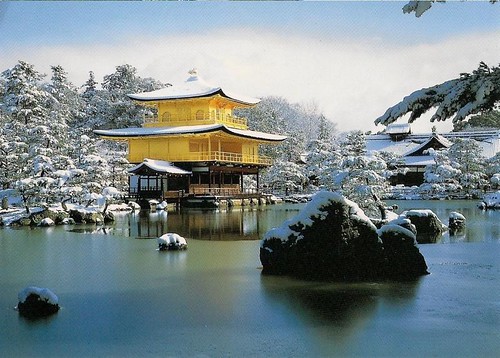

Japan-16, originally uploaded by Abhishek's Received Postcards.

Kinkaku-ji, or formally Rokuon-ji is a Zen Buddhist temple in Kyoto, Japan.
Kinkaku-ji was originally built in 1397 to serve as a retirement villa for Shogun Ashikaga Yoshimitsu, as part of his estate then known as Kitayama. It was his son who converted the building into a Zen temple of the Rinzai school.

The Golden Pavilion, or Kinkaku, is a three-story building on the grounds of the Rokuon-ji temple complex. The top two stories of the pavilion are covered with pure gold leaf. The pavilion functions as a shariden, housing relics of the Buddha (Buddha's Ashes). The top floor is built in traditional Chinese cha'an style, also known as zenshu-butsuden-zukuri; and the middle floor in the style of warrior aristocrats, or buke-zukuri. The ground floor is rendered in shinden-zukuri style, reminiscent of the residential style of the Heian imperial aristocracy. The building is often linked or contrasted with Ginkaku-ji (Silver Pavilion Temple), and Shōkoku-ji, which are also located in Kyoto.

Read more...

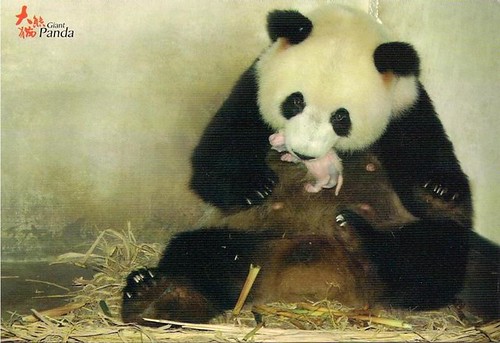
Sichuan Giant Panda Sanctuaries, China


China-54, originally uploaded by Abhishek's Received Postcards.

The Giant Panda newborn is small and underdeveloped and the rely completely on the care of their mother.

The Sichuan Giant Panda Sanctuaries located in southwest Sichuan province of China, is the home to more than 30% of the world's highly endangered Giant Pandas and is among the most important sites for the captive breeding of these pandas. It covers 9245 km² with seven nature reserves and nine scenic parks in the Qionglai and Jiajin Mountains. Along with the Giant Panda, the sanctuary is a refuge to other endangered species such as the red panda, the snow leopard, and the clouded leopard. Outside of the tropical rainforests, it is among the botanically richest sites of the world, and is home to between 5,000 and 6,000 species of flora. It has been noted that the region is similar to the paleo-tropic forests of the Tertiary Era.

Read more...

Sunday, July 26, 2009

Panoramic Sight with the main square, Machu Picchu, Peru


Peru-2, originally uploaded by Abhishek's Received Postcards.

Machu Picchu is a pre-Columbian Inca site located 2,430 metres (8,000 ft) above sea level. It is situated on a mountain ridge above the Urubamba Valley in Peru, which is 80 kilometres (50 mi) northwest of Cuzco and through which the Urubamba River flows. Often referred to as "The Lost City of the Incas", Machu Picchu is one of the most familiar symbols of the Inca Empire.

Read more...

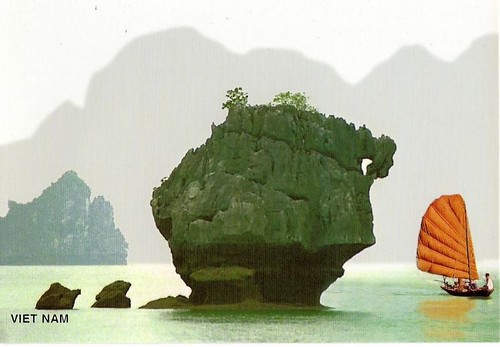
Tach Island (Cup Island), Ha Long Bay, Viet Nam


Vietnam-4, originally uploaded by Abhishek's Received Postcards.

Hạ Long Bay is a UNESCO World Heritage site located in Quảng Ninh province, Vietnam. The bay features thousands of limestone karsts and isles in various sizes and shapes.

Local legend has it that long ago, when the Vietnamese were fighting Chinese invaders, the gods sent a family of dragons to help defend the land. This family of dragons began spitting out jewels and jade. These jewels turned into the islands and islets dotting the bay, linking together to form a great wall against the invaders. The people kept their land safe and formed what later became the country of Vietnam. After that, dragons were interested in peaceful sightseeing of the Earth and decided to live here then. The place where Mother Dragon flew down was named Hạ Long, the place where the dragon children attended upon their mother was called Bái Tử Long island (Bái: attend upon, Tử: children, Long: dragon), and the place where the dragon children wriggled their tails violently was called Bạch Long Vỹ island (Bạch: white- colour of the foam made when Children Dragon wriggle, Long: dragon, Vỹ: tail).

Read more...

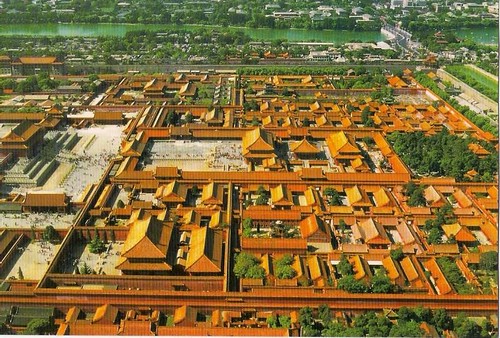
A bird's-eye view of the Forbidden City, China


China-49, originally uploaded by Abhishek's Received Postcards.


The Forbidden City was the Chinese imperial palace from the Ming Dynasty to the end of the Qing Dynasty. It is located in the middle of Beijing, China, and now houses the Palace Museum. For almost five centuries, it served as the home of the Emperor and his household, as well as the ceremonial and political centre of Chinese government.
Built from 1406 to 1420, the complex consists of 980 surviving buildings with 8,707 bays of rooms and covers 720,000 square metres (7,800,000 square feet). The palace complex exemplifies traditional Chinese palatial architecture,[2] and has influenced cultural and architectural developments in East Asia and elsewhere. The Forbidden City was declared a World Heritage Site in 1987, and is listed by UNESCO as the largest collection of preserved ancient wooden structures in the world.

Read more...

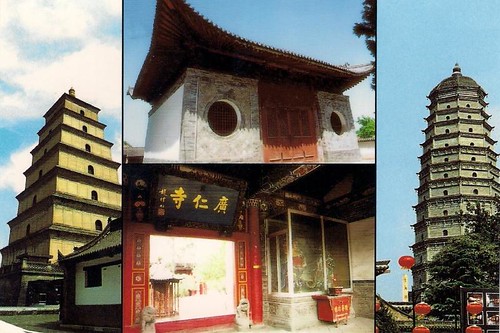
Several Temples, China


China-55, originally uploaded by Abhishek's Received Postcards.

| 2 |
1 | 3 | 4
| |

1.The big wild Goose Pagoda

Giant Wild Goose Pagoda or Big Wild Goose Pagoda, is a Buddhist pagoda located in southern Xi'an, Shaanxi province, China. It was built in 652 during the Tang Dynasty and originally had five stories, although the structure was rebuilt in 704 during the reign of Empress Wu Zetian and its exterior brick facade renovated during the Ming Dynasty. One of the pagoda's many functions was to hold sutras and figurines of the Buddha that were brought to China from India by the Buddhist translator and traveller Xuanzang.

2. Zhao Ren Temple

Zhaoren Temple, located in Zhang Wuxian City Street northbound. Tang Zhenguan years built. 3 temple only three ordinary brick room, the door in the door of that "Zhaoren Temple" words.

3. Guang Ren Temple
It is situated in Xi'an.It is consecrated to Princess Wencheng who married the leader of Tibet. She promoted the relationship between Tang and Tibet.

4. The Famen Temple
Famen Temple is located in Famen town, Fufeng County, 120 kilometer west of Xi'an City, Shaanxi Province. It was widely regarded as the "ancestor of pagoda temples in Guanzhong area".

Read more...

Terra-cotta Warriors and Horses, China


China-50, originally uploaded by Abhishek's Received Postcards.


China-51, originally uploaded by Abhishek's Received Postcards.


The Terracotta Army are the Terra Cotta Warriors and Horses of Qin Shi Huang the First Emperor of China. The terracotta figures, dating from 210 BCE, were discovered in 1974 by some local farmers near Xi'an, Shaanxi province, China near the Mausouleum of the First Qin Emperor. The figures vary in height (183–195 cm - 6ft–6ft 5in), according to their role, the tallest being the generals. The figures include strong warriors, chariots, horses, officials, acrobats, strongmen, and musicians. Current estimates are that in the three pits containing the Terracotta Army there were over 8,000 soldiers, 130 chariots with 520 horses and 150 cavalry horses, the majority of which are still buried in the pits.

Read more...

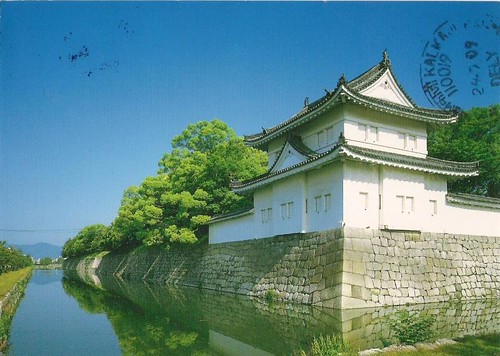
Nijo Castle, Kyoto, Japan


Japan-17, originally uploaded by Abhishek's Received Postcards.

Inner Moat and Gate to the Hommaru Palace


Japan-17, originally uploaded by Abhishek's Received Postcards.


Nijo Castle is a flatland castle located in Kyoto, Japan. The castle consists of two concentric rings of fortifications, the Ninomaru Palace, the ruins of the Honmaru Palace, various support buildings and several gardens. The surface area of the castle is 275,000 square meters, of which 8000 square meters is occupied by buildings.

The Nijo Castle has two concentric rings of fortifications, each consisting of a wall and a wide moat. The outer wall has three gates while the inner wall has two. In the southwest corner of the inner wall, there are foundations of a five-story keep, destroyed by a fire in 1750. The inner walls contain the Honmaru Palace with its garden. The Ninomaru Palace, Kitchens, Guard House and several gardens are located between the two main rings of fortifications.

Read more...

Rock Garden, Ryoan-Ji Temple, Kyoto, Japan


Japan-15, originally uploaded by Abhishek's Received Postcards.

Ryoan-ji is a Zen temple located in northwest Kyoto, Japan. Belonging to the Myoshin-ji school of the Rinzai branch of Zen Buddhism, the temple is one of the Historic Monuments of Ancient Kyoto, a UNESCO World Heritage Site.

To many, the temple's name is synonymous with the temple's famous karesansui (dry landscape) rock garden, thought to have been built in the late 1400s. The garden consists of raked gravel and fifteen moss-covered boulders, which are placed so that, when looking at the garden from any angle (other than from above) only fourteen of the boulders are visible at one time. It is traditionally said that only through attaining enlightenment would one be able to view the fifteenth boulder.

Read more...

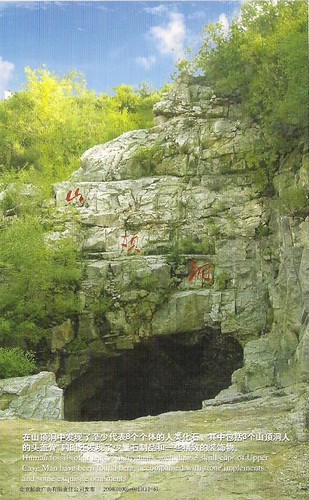
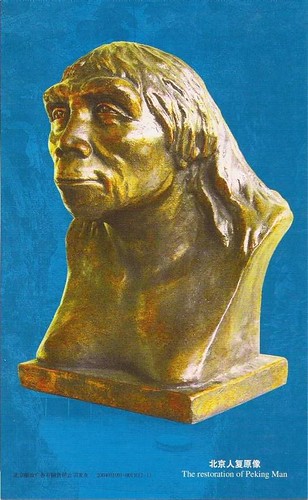
Peking Man Site at Zhoukoudian, China


China-52, originally uploaded by Abhishek's Received Postcards.


China-53, originally uploaded by Abhishek's Received Postcards.


Zhoukoudian or Choukoutien is a cave system in Beijing in China. It has yielded many archaeological discoveries, including one of the first specimens of Homo erectus, dubbed Peking Man, and a fine assemblage of bones of the gigantic hyena Pachycrocuta brevirostris. The Peking Man lived in this cave approximately 200,000 to 750,000 years ago, if evolutionary science is true.
The Peking Man Site was discovered by Johan Gunnar Andersson in 1921 and was first excavated by Otto Zdansky in 1921 and 1923 unearthing two human teeth. These were later identified by Davidson Black as belonging to a previously unknown species and extensive excavations followed.

As per UNESCO WHS website:
Scientific work at the site, which lies 42 km south-west of Beijing, is still underway. So far, it has led to the discovery of the remains of Sinanthropus pekinensis, who lived in the Middle Pleistocene, along with various objects, and remains of Homo sapiens sapiens dating as far back as 18,000–11,000 B.C. The site is not only an exceptional reminder of the prehistorical human societies of the Asian continent, but also illustrates the process of evolution.

Read more...