Tuesday, December 22, 2009

Plantin-Moretus Museum, Antwerp, Belgium


Belgium-9, originally uploaded by Abhishek's Received Postcards.


Belgium-10, originally uploaded by Abhishek's Received Postcards.


Belgium-11, originally uploaded by Abhishek's Received Postcards.

The Plantin-Moretus Museum is a museum in Antwerp, Belgium honouring the famous printers Christoffel Plantijn and Jan Moretus. It is located in their former residence and printing establishment, Plantin Press, at the Friday Market.
This postcard shows the Drawing Room of the Wall Tapestries.

Read more...

Canterbury Cathedral, United Kingdom

Canterbury Cathedral in Canterbury, Kent, is one of the oldest and most famous Christian structures in England and forms part of a World Heritage Site. It is the cathedral of the Archbishop of Canterbury, leader of the Church of England and symbolic leader of the worldwide Anglican Communion. Its formal title is the Cathedral and Metropolitical Church of Christ at Canterbury.

Read more...

Tenerife Island, Spain


Spain-13, originally uploaded by Abhishek's Received Postcards.

Tenerife, a Spanish island, is the largest of the seven Canary Islands in the Atlantic Ocean off the coast of Africa. Tenerife also has the highest elevation of Spain, a World Heritage Site that is the third largest volcano in the world from its base, El Teide. It is an active volcano which last erupted in 1909. The volcano and its surroundings comprise the Teide National Park (Parque Nacional del Teide in Spanish).

Read more...

Redwood National and State Park, USA


USA-40, originally uploaded by Abhishek's Received Postcards.

The Redwood National and State Parks (RNSP) are located in the United States, along the coast of northern California. The parks consist of a combined area of 131,983 acres (534.12 km2) located entirely within Del Norte and Humboldt Counties and they protect 45% of all remaining Coastal Redwood (Sequoia sempervirens) old-growth forests, totaling at least 38,982 acres (157.75 km2). These trees are the tallest and one of the most massive tree species on Earth. In addition to the redwood forests, the parks preserve other indigenous flora, fauna, grassland prairie, cultural resources, portions of rivers and other streams, and 37 miles (60 km) of pristine coastline.

Read more...

Saint-Émilion, France


France-18, originally uploaded by Abhishek's Received Postcards.

Saint-Émilion is a commune in the Gironde department in Aquitaine in south-western France.
Saint-Émilion's history goes back to prehistoric times and is a World Heritage site, with fascinating Romanesque churches and ruins stretching all along steep and narrow streets.
The Romans planted vineyards in what was to become Saint-Émilion as early as the 2nd century AD. In the 4th century, the Latin poet Ausonius lauded the fruit of the bountiful vine.
The town was named after the monk Émilion, a travelling confessor, who settled in a hermitage carved into the rock there in the 8th century. It was the monks who followed him that started up the commercial wine production in the area.

Read more...

Hôtel-Dieu de Lyon, France


France-17, originally uploaded by Abhishek's Received Postcards.

Hôtel-Dieu de Lyon is a functioning hospital of historical significance situated on the west bank of the Rhone river, on the "Presque-isle".
Lyon, often Anglicized as Lyons, is a city in east-central France in the region Rhône-Alpes, situated between Paris and Marseille. Lyon is located at 470 km from Paris, 320 km from Marseille, 160 km from Geneva, 280 km from Turin, 450 km from Milan and 600 km from Barcelona. The residents of the city are called Lyonnais.
Lyon is a major centre of business with a reputation as the French capital of gastronomy and having a significant role in the history of cinema due to Auguste and Louis Lumière. The local professional football team, Olympique Lyonnais, has increased the profile of Lyon internationally through participation in European football championships.

Read more...

Cathedral of Notre-Dame, Reims, France


France-16, originally uploaded by Abhishek's Received Postcards.

Notre-Dame de Reims (Our Lady of Rheims) is the Roman Catholic cathedral of Reims, where the kings of France were once crowned.[1] It replaces an older church, destroyed by a fire in 1211, which was built on the site of the basilica where Clovis was baptized by Saint Remi, bishop of Reims, in AD 496. That original structure had been erected on the site of the Roman baths. As the cathedral it remains the seat of the Archdiocese of Reims.
A major site for tourism in the Champagne region, it accommodated half a million visitors in 2006

Read more...

Avignon , France


France-15, originally uploaded by Abhishek's Received Postcards.

Avignon is a commune in the Vaucluse department in southeastern France.The city is well known for its Palais des Papes (Palace of the Popes), where several popes and antipopes lived from the early 14th to early 15th centuries.
Avignon is situated on the left bank of the Rhône, a few miles above its confluence with the Durance, about 580 km (360.4 mi) south-south-east of Paris. Avignon occupies a large oval-shaped area, not fully populated and covered in great part by parks and gardens.

Read more...

Pont du Gard, France


France-14, originally uploaded by Abhishek's Received Postcards.

The Pont du Gard is an aqueduct in the South of France constructed by the Roman Empire, and located in Vers-Pont-du-Gard near Remoulins, in the Gard département. Pont du Gard means literally bridge of the Gard (river). The Gard River, which has given its name to the Gard département, does not actually exist under this name. The river, formed by many tributaries, several of which are called Gardon, is itself called Gardon until its end.The Pont du Gard was added to UNESCO's list of World Heritage Sites in 1985.

Read more...

Saturday, December 5, 2009

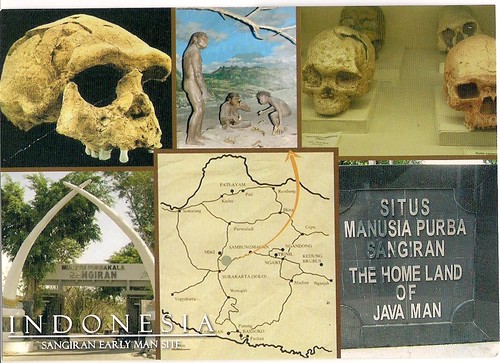
Sangiran Early Man Site, Indonesia

Sangiran is an archaeological excavation site at the island of Java in Indonesia. The area comprises about 48 km² and is located in Central Java, about 15 kilometers north of Surakarta in the Solo River valley. In 1996 it was accepted as World Heritage by the UNESCO.
In 1934 the anthropologist Gustav Heinrich Ralph von Koenigswald started to examine the area. During excavations in the next years fossils of some of the first known human ancestors, Pithecanthropus erectus ("Java Man", now reclassified as part of the species Homo erectus), were found here. About 60 more human fossils, among them the enigmatic "Meganthropus", have since been found here. In addition, there are considerable numbers of remains of the animals that these primitive humans hunted, and of others that merely shared the habitat.

Read more...